
How Reference Images Help You Write Better Characters

Sandra Spellman has been living in my head for a while, and I finally got a chance to put her on the page in Cursed to Wither. She’s technically a secondary character, but I don’t think Sandra got that memo. She walked into the story with far too much presence for that.
A while back, I got a piece of writing advice that stayed with me: include an older character in a series. Someone with history. Someone with perspective. Someone with that unmistakable “I’ve seen some things” energy. The second Sandra showed up, I knew she was that character for me.
Sandra is a witch, very proudly, from a long line of witches. She’s also the great-aunt to the Statera siblings you met in Cursed to Dream, which means she comes with history, opinions, and exactly the kind of confidence that makes everyone around her straighten up a little. She’s seventy-two, flamboyant, full of life, and completely uninterested in making herself smaller to make anyone else comfortable.
She loved her husband deeply and still speaks about him with that soft, steady kind of devotion that tells you the love was real. She also loves speed dating, which honestly makes me adore her even more. Sandra didn’t survive decades of life and loss just to sit quietly at home.
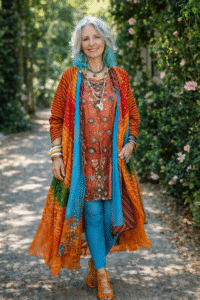
One of the trickiest parts of writing her was figuring out how to describe her in a way that felt vivid without turning into a fashion catalogue. Sandra’s style is a lot, in the best possible way: scarves, bangles, layers, color, texture, confidence. She doesn’t just walk into a room quietly. She arrives.
But that wasn’t the biggest challenge.
Sandra was such an interesting, vibrant character that I also had to make sure she didn’t steal the limelight. That’s a real balancing act with secondary characters. You want them to feel alive and you want them to have presence and personality and a life beyond the page. At the same time, you have to protect the heart of the story.
In Cursed to Wither, that heart is still the conflict and love story between the main characters. Sandra couldn’t be allowed to pull focus every time she appeared, no matter how much fun she was to write. I actually chose not to put her in more scenes for that reason. I’ve watched plenty of movies where the side character or sidekick is more interesting than the lead, and while that can be fun as a viewer, it’s a harder thing to manage when you’re building a story that needs the emotional center to stay with the main couple.
That’s part of what made reference images so helpful.
I went down a bit of a Pinterest rabbit hole while I was working out how to picture Sandra, and what helped was not finding one perfect image that matched exactly what I wanted to write. What helped was finding a consistent visual. A theme. A vibe. A feeling. Once I had that, Sandra became easier to hold steady in my mind.
That consistency mattered more than I expected. It meant that even when I put her in a different outfit on the page, I could still maintain the same sense of who she was. I wasn’t trying to copy one exact look. I was trying to stay true to Sandra’s energy, which is bold, warm, and dramatic in the best way. Also, a little eccentric and she’s entirely comfortable in her own skin.
That’s what the images gave me. Not just a clothing style, but a character I could return to consistently.
And the helpful part is that images can give you more than clothes. They can give you clues about personality too. The way someone stands. The expression on their face. Their posture. Whether they seem playful, guarded, amused, commanding, soft, mischievous, or completely unbothered by anyone else’s opinion. Whether they are holding something or whether they look like they’re about to say exactly what they think and dare you to object.
All of that can tell you something.
That was especially useful with Sandra because her clothes are not just clothes. They’re part of how she moves through the world. Not literally magical, but expressive in a way that tells you something about her before she ever speaks. She’s not trying to blend in. She knows who she is, and she’s perfectly happy for you to know it too.
That helped me on the page because I wasn’t choosing details at random. I was choosing details that felt like Sandra.
I think that’s probably the biggest takeaway for me as a writer. You don’t need a picture of exactly what you plan to write. You just need something that helps you hold onto the character’s theme. A visual thread. A consistent mood. A way of seeing them that lets you write them clearly and consistently, even when the scene changes.
For me, that meant I could put Sandra in different outfits and still keep the same vibe for her. She still felt like the same woman every time she appeared. And that consistency helped in another way too. It let me write her vividly without overusing her. I could make her memorable on the page, trust the impression she left, and then step back so the story could stay where it belonged.
Sandra may not be the main character in Cursed to Wither, but I wanted her to feel bigger than life anyway, but without stealing the show. The kind of woman who makes you smile the second she appears. The kind of woman who feels fully herself.
Sometimes reference images help me with setting. Sometimes they help with mood. And sometimes, like they did here, they help me bring a character into focus in a way that feels clear, consistent, and alive.
Sandra had already been living in my head. The images just helped me see her clearly enough to put her on the page.